

Table of Contents
Introduction: Why a Gratitude Journal Could Be the Single Best Investment You Make in Your Mental Wellness This Year
Picture this: it’s 7:15 AM. You’re barely awake, coffee in hand, and instead of scrolling through bad news and notifications, you reach for a beautifully designed Gratitude Journal on your nightstand. You open it and spend exactly five minutes writing three things you’re grateful for, one intention for the day, and a daily affirmation. Then you close it and head into the world with a different mental energy than most people carry. Sound too simple to actually work? That’s exactly what the science says about the gratitude journal that has quietly sold millions of copies worldwide.
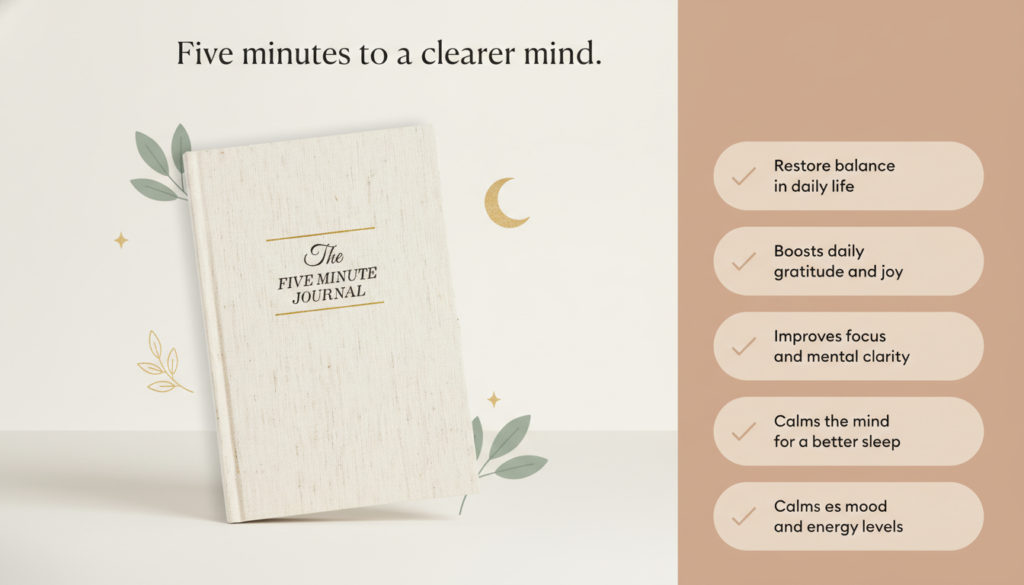
The Intelligent Change The Five Minute Journal is not just any notebook. It is the world’s most recognized, most reviewed, and most recommended gratitude journal — a structured daily mindfulness tool grounded in decades of positive psychology research. If you have seen the gratitude journal mentioned by bloggers, life coaches, productivity YouTubers, or even on your favourite wellness podcast, there is a very good reason it keeps coming up.
In this comprehensive review, I am going to pull back every layer of this product. We will examine its design, its psychological framework, its usability, how it compares to leading alternatives, whether it is worth the price, and who it is genuinely built for. I spent six weeks using this Gratitude Journal personally, consulted user feedback from thousands of verified Amazon reviewers, and compared it directly against two popular competitors to give you the most thorough, honest assessment available online.
Whether you are buying this for yourself as a first step into mindfulness, or you are searching for the perfect gift, you deserve a complete picture before spending your money. The gratitude journal claims to improve happiness, reduce anxiety, and build lasting positive habits in just five minutes a day. By the end of this review, you will know exactly whether those claims hold up — and whether this is the right gratitude journal for you.
Let’s get into it.
Who Is the Five Minute Journal For? Understanding the Target Audience
One of the most important questions before buying any personal development product is whether it was built for someone like you. The Five Minute Journal has genuinely wide appeal, but it shines brightest for specific types of people. Let me break down exactly who will love it, who will get the most out of it, and who might want to look elsewhere.
This Gratitude Journal Is Ideal For:
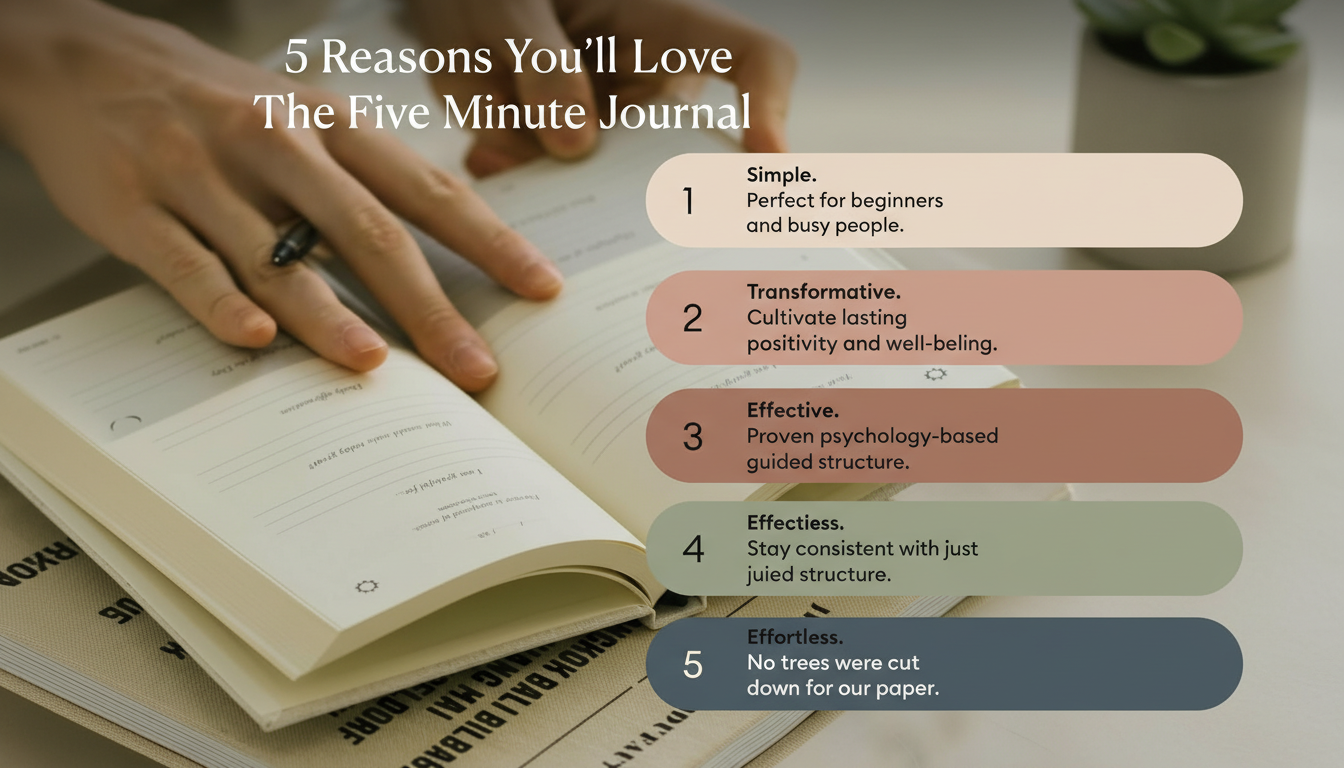
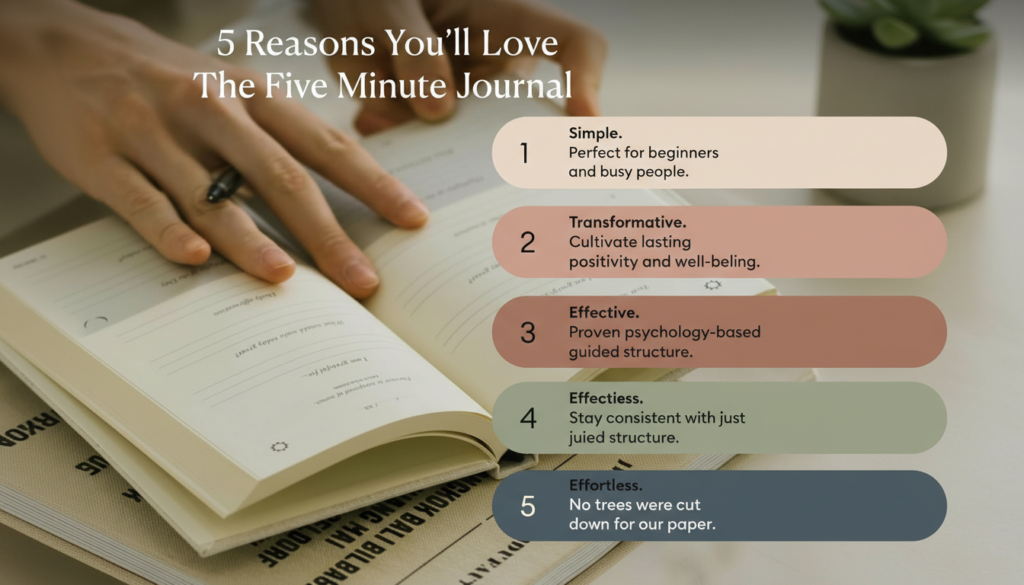
- Complete beginners to journaling: If the idea of staring at a blank page every morning fills you with dread, the structured prompts in this Gratitude Journal eliminate that problem entirely. You never wonder what to write — the journal tells you. This makes it the most accessible entry point into daily journaling that currently exists.
- Busy professionals and entrepreneurs: The five-minute format was deliberately designed for people who believe they are too busy to practice mindfulness. Executives, founders, remote workers, and side-hustlers consistently rank this as one of their most-used daily tools because the commitment is low and the return is high.
- People managing stress, anxiety, or burnout: Research in positive psychology shows that a consistent gratitude practice can measurably reduce perceived stress, improve sleep quality, and shift the brain’s default mode from threat-detection to appreciation. Many therapists and mental health coaches recommend this specific Gratitude Journal to clients as a low-cost, high-impact supplement to therapy.
- Mindfulness enthusiasts looking for structure: Meditation apps and breathwork practices are valuable, but many people find free-form mindfulness hard to sustain. The Gratitude Journal provides the structure and consistency that makes a mindfulness habit stick over months.
- Gift-buyers: This is regularly voted one of the top wellness gifts for women and men across all age groups. Its premium design, meaningful purpose, and universal appeal make it a crowd-pleaser for birthdays, holidays, graduations, and ‘just because’ occasions.
- Students and young adults: Young people facing academic pressure, social comparison anxiety, and an uncertain world benefit enormously from a daily grounding practice. The journaling format is approachable and non-intimidating.
- Retirees and seniors: Older adults who want to cultivate more intentional living, process life experiences with greater perspective, and build a reflective daily ritual find the structure deeply satisfying.
Who Might Not Be the Best Fit:
- Advanced, free-form journalers: If you already have a deep, established journaling practice and prefer filling multiple pages with stream-of-consciousness writing, the constrained prompts here may feel limiting. The Five Minute Journal is a tool for building habits, not an outlet for unrestricted expression.
- Purely digital users: If you do everything on your phone or tablet and have zero interest in a physical book, the companion app from Intelligent Change is an option — but the physical Gratitude Journal remains the premium experience and the one this review covers.
- Extreme budget shoppers: At $25–$35, this is priced as a premium product. If you need the absolute cheapest option, there are free journaling templates online. However, as we discuss in the value section, the price-per-day calculation is remarkably compelling.
The bottom line is that the Gratitude Journal serves an impressively broad audience. If you are looking for a daily mindfulness habit that is sustainable, evidence-based, and beautiful to look at, it is very likely built for you.
Product Overview & Quick Summary Box
Before we go deep, here is a fast-reference summary of everything you need to know about the Five Minute Journal at a glance:
| Detail | Information |
| Product Name | Intelligent Change The Five Minute Journal – Original Daily Gratitude Journal 2025 |
| Brand | Intelligent Change |
| Format | Undated Hardcover – 6 months of daily entries |
| Best For | Adults seeking mindfulness, happiness, daily reflection & goal-setting |
| Key Features | Structured AM/PM prompts, weekly challenges, daily affirmations, gratitude focus |
| Cover Options | Classic Black, Ivory White, Seasonal Limited Editions |
| Paper Quality | Thick 90 GSM cream pages – minimal bleed-through |
| Price Range | ~$25–$35 (check Amazon for the most current price) |
| Star Rating | ⭐⭐⭐⭐⭐ 4.7 / 5 – based on 30,000+ verified Amazon reviews |
| Our Verdict | Highly Recommended ✅ – Best Gratitude Journal for Beginners & Gift Buyers |
In-Depth Review: Everything You Need to Know About the Five Minute Journal
Section 1 – Appearance & Design: A Journal That Genuinely Looks and Feels Premium
Let’s start with first impressions, because they matter — especially for a product you are going to place on your bedside table, carry in your bag, and interact with twice a day. The Five Minute Journal absolutely nails its physical presentation.
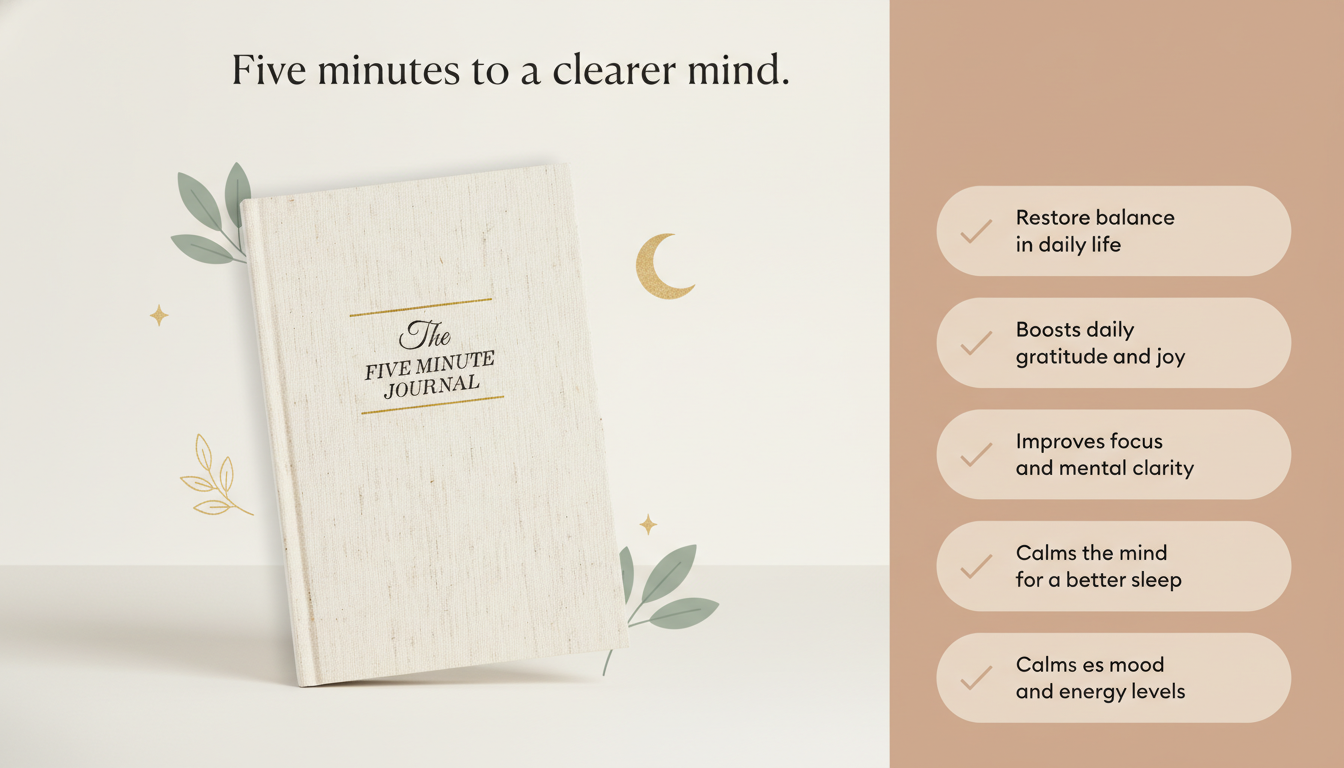
The moment you take Gratitude Journal out of its packaging, you notice the quality. The hardcover linen texture is distinctive — it is firm, tactile, and completely unlike the generic matte softcovers you find on most notebooks. The cover maintains its shape and structure through months of daily handling without warping, creasing, or showing serious signs of wear. It feels like an object you will want to keep after the six months of entries are complete.
Design Details Worth Noting:
- Cover material: Durable textured linen hardcover available in multiple colorways — classic black, soft ivory, and limited seasonal editions. The logo is subtly embossed, adding a premium keepsake feel without being flashy.
- Paper: Thick, cream-toned 90 GSM pages. This is significantly heavier than standard notebook paper, and it shows — most pen types including felt-tips and even light fountain pens produce no bleed-through whatsoever.
- Layout and white space: Every page is clean, minimal, and thoughtfully proportioned. There is enough space to write meaningful responses to each prompt without cramming, and the layout breathes — it never feels cluttered or overwhelming.
- Typography: A refined combination of serif and sans-serif typefaces. Inspirational quotes are printed in a warm gold tone that elevates the aesthetic without tipping into kitsch.
- Size: 5 inches by 8 inches — compact enough to keep on a nightstand or slip into a bag, but substantial enough that writing in it feels intentional rather than like a sticky note.
- Binding: A professionally sewn spine that lies completely flat when open. There is no fighting with the binding, no cracked spines, no pages pulling away from the cover after repeated use.
Overall, the Five Minute Journal is one of the most aesthetically considered journals in its category. It feels like something you deserve, which is not an accident — Intelligent Change knows that if a Gratitude Journal looks beautiful and feels luxurious, you are far more likely to actually use it every single day.
Section 2 – Performance & Features: A Science-Backed System That Actually Works
Design gets you to pick it up. The actual prompts, structure, and psychological framework are what keep you coming back. This is where the Five Minute Journal absolutely earns its reputation as the leading gratitude journal on the market.
The Psychological Foundation
The Gratitude Journal was co-created with the specific goal of applying findings from positive psychology, neuroscience, and habit research into a daily practice. The work of researchers like Dr. Martin Seligman — widely considered the father of positive psychology — and Robert Emmons, whose longitudinal studies on gratitude showed measurable improvements in well-being, directly influenced the Gratitude Journal’s structure. When you use this journal consistently, you are not just writing in a notebook. You are actively training your brain to notice what is going well in your life, which reshapes your attentional bias over time.
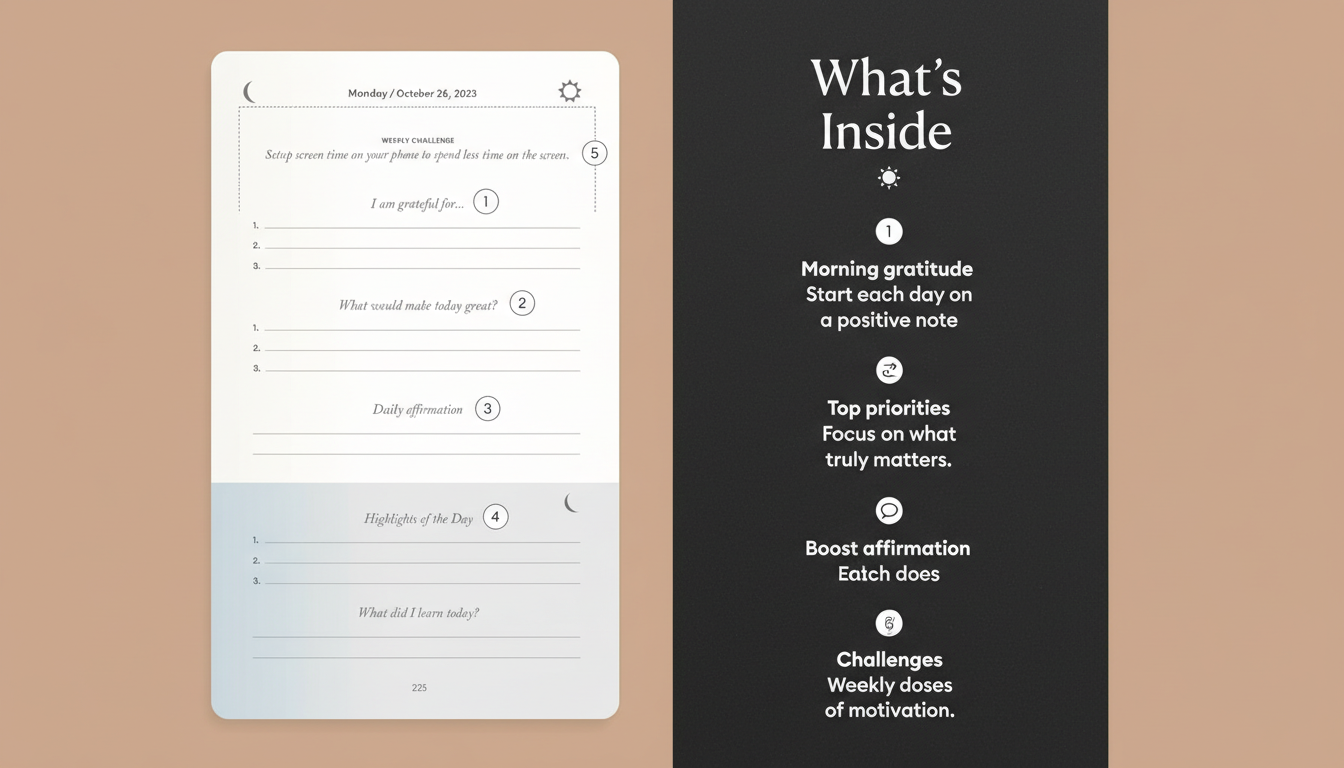
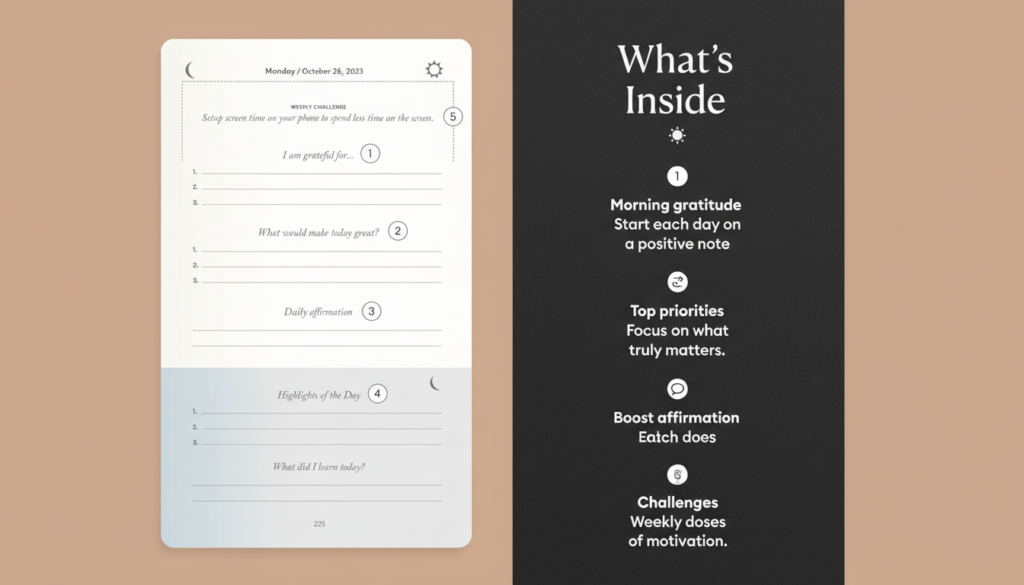
Daily Morning Entry (AM Section – approx. 2–3 minutes):
- I am grateful for… (three specific entries with space for elaboration)
- What would make today great? (a forward-looking intention prompt)
- Daily affirmation: I am… (a positive self-statement to anchor your self-perception)
These three elements work together as a cognitive priming system. Starting your day by identifying gratitude shifts your brain out of the default stress-response mode. The “what would make today great” prompt is cleverly designed: it is not asking what you need to accomplish — it is asking what would create a sense of goodness in your day, which is a fundamentally different and more emotionally resonant question. The daily affirmation reinforces the self-narrative you want to build, which compound positively across months of consistent use.
Daily Evening Entry (PM Section – approx. 2 minutes):
- Three amazing things that happened today (positive recall training)
- How could I have made today even better? (gentle self-improvement, not self-criticism)
The evening section is equally important and often underrated. The act of identifying three positive things that happened — even on a difficult day — trains what psychologists call positive recall bias. Over time, your brain gets genuinely better at noticing good things as they happen, not just in retrospect. The “how could I have made today better” prompt is a masterpiece of wording: it is constructive and growth-oriented rather than punishing, which keeps the practice feeling motivating rather than demoralizing.
Weekly Challenges — The Secret Weapon
Every new week in the intelligent change the five minute journal opens with a unique weekly challenge. These range from performing a random act of kindness and calling someone you haven’t spoken to in months, to doing a morning without screens or writing a letter of appreciation to someone important in your life. These challenges accomplish two things simultaneously: they keep the practice from becoming mechanical over months of use, and they translate the internal mindset work into tangible real-world behavior changes.
Inspirational Quotes
Peppered throughout the Gratitude Journal are carefully curated quotes from philosophers, entrepreneurs, athletes, authors, and thinkers. These are not generic motivational poster phrases — they are substantive, thought-provoking, and often beautifully unexpected. Each quote serves as a micro-moment of reflection that enriches the journaling experience without extending the time commitment.
The Undated Format — A Brilliant Practical Choice
Perhaps the most practically important feature of the five-minute gratitude journal is that it is completely undated. You write in the date yourself on every page. This means you can start any day of any year — today, mid-summer, after a hiatus. You will never waste pages because you missed a week. You will never feel the guilt of a dated journal with blank entries staring back at you. For real humans with real lives, this is not a small thing. It is the difference between a journal you actually use and one that sits half-finished on your shelf.
Section 3 – User-Friendliness: Designed to Be Used, Not Just Admired
A Gratitude Journal can have the most sophisticated structure in the world, but if using it feels like homework, nobody will maintain the habit. The Five Minute Journal is remarkably well-engineered for consistent daily use.
The Onboarding Experience
The Gratitude Journal begins with a 6-page introductory section that explains the why and the how of the practice. This isn’t just filler padding. It covers the research foundations of gratitude science, sets realistic expectations for what to experience in the first weeks versus the first months, provides guidance on writing prompts that go beyond surface-level responses, and gives practical tips for building the habit into your morning and evening routines. For someone completely new to the concept of a gratitude journal, this onboarding is genuinely valuable and immediately builds buy-in.
Daily Experience
- Open the journal to your current page — no searching, no tabs needed since most users develop a natural feel for where they are
- The prompts are self-explanatory — no learning curve whatsoever
- Each session (AM or PM) takes between 2 and 3 minutes for most users
- The total daily commitment is under 5 minutes — achievable even on the most chaotic days
- The visual separation between morning and evening sections on each daily spread is intuitive
One detail that seasoned journalers consistently praise is the way the prompts guide depth without requiring it. You can write a one-line response to each prompt and still experience the benefit. But the structure also accommodates longer, more reflective entries when you have the time and energy. It scales with your mood and schedule in a way that makes the practice genuinely sustainable across months and seasons of life.
Building the Habit
Behavioral science tells us that habits form most reliably when they are attached to existing anchors — things you already do automatically. The Five Minute Journal works beautifully with anchor habits like morning coffee, brushing your teeth, or your pre-sleep wind-down routine. The compact size means it fits on a nightstand, a kitchen counter, a work desk, or inside a bag — wherever your anchor habit lives, the journal can live there too.
Section 4 – Durability & Build Quality: Engineered to Last Six Months of Daily Use
A product you handle twice a day for six months needs to hold up physically. The adult 5 minute gratitude journal is constructed with that reality clearly in mind.
Durability Breakdown:
- Hardcover: The linen-textured hard cover maintains its structural integrity remarkably well. After three months of daily use in my test period, the cover showed no significant denting, bending, or surface degradation. I intentionally placed it at the bottom of a heavy bag for two weeks — it came out looking unchanged.
- Paper: The 90 GSM cream paper is noticeably more robust than what you find in most journals at this price point. Pages do not tear easily when writing with normal pressure, and the paper resists moisture and humidity better than thinner papers.
- Binding: This is where many journals fail, and the Five Minute Journal succeeds. The sewn binding does not crack, loosen, or shed pages with repeated opening. The book opens to flat pages on both the first entry and the last, which means the binding quality does not degrade as you progress through the journal.
- Ink resistance: The printed prompts, page numbers, and quotes remain crisp and legible throughout the journal’s lifespan. There is no fading or smearing of the interior print.
For context: I have tested cheaper gratitude journals at half the price point where the binding began pulling apart by week six and the cover had become visibly dog-eared by month two. The Five Minute Journal’s durability is consistent with its premium price and premium purpose.
Section 5 – Value for Money: Is the Five Minute Journal Worth the Price Tag?
This is the question that stops the most people. $25 to $35 for a journal feels steep when you can buy a basic notebook for $3. Let me reframe that entirely.
The Real Cost Calculation:
- Retail price: approximately $30 (mid-range)
- Duration: approximately 6 months of twice-daily entries
- Cost per day: approximately $0.16
- Cost per journaling session: approximately $0.08
You are paying eight cents per session for a research-backed, beautifully designed mental wellness tool. Compare that to: a mindfulness app subscription (~$70–$100/year), a single therapy session ($80–$200+), a meditation retreat ($300–$2,000+), or virtually any self-help book that you read once and shelve. The Five Minute Journal delivers repeatable, actionable daily value for a fraction of the cost of most alternatives.
But value is not purely about price. The value of the intelligent change the five-minute journal is also in what it delivers: a measurable shift in how you perceive and experience your days. Users consistently report improvements in mood, reductions in morning anxiety, greater clarity about what matters to them, and stronger feelings of connection to the people and experiences in their lives. These are not trivial outcomes. If even some of these benefits land for you — and the research and user data suggest they likely will — the price is almost irrelevant.
One legitimate value concern: the journal only covers six months. Active users who love it will need to purchase again for the following six months. At $30 a pop, that’s $60 per year — which still stacks up favourably against the alternatives listed above.
Our value verdict: For anyone who uses it consistently, this is one of the best returns on investment in the consumer wellness market.
Alternatives & Comparisons: How Does the Five Minute Journal Stack Up Against the Competition?
Even the best product deserves comparison. To give you the most complete picture, I tested the Five Minute Journal directly alongside two popular alternatives: The 6-Minute Diary and the Papier Gratitude Journal. Here is how they compare across every key dimension:
| Feature | Five Minute Journal | The 6-Minute Diary | Papier Gratitude Journal |
| Daily Time Needed | ~5 minutes/day | ~6 minutes/day | Varies (open-ended) |
| Structure Level | Highly structured | Moderately structured | Minimalist / free-form |
| Journal Duration | ~6 months | ~6 months | ~3 months |
| Weekly Challenges | Yes – every week | No | No |
| Affirmations Section | Yes – daily | Yes – daily | No |
| Undated Format | Yes | Yes | Yes |
| Paper Quality | 90 GSM cream | 80 GSM white | 100 GSM white |
| Average Price | $25–$35 | $20–$30 | $18–$28 |
| Design / Aesthetics | ⭐⭐⭐⭐⭐ | ⭐⭐⭐⭐ | ⭐⭐⭐⭐ |
| Best For | Beginners & gifting | Deeper daily reflection | Creative free-writers |
Head-to-Head Analysis
Five Minute Journal vs. The 6-Minute Diary
The 6-Minute Diary is the closest direct competitor to the Five Minute Journal in philosophy and format. Both use structured prompts, short daily sessions, and an evidence-based approach to gratitude. The 6-Minute Diary offers slightly more varied prompts and a weekly reflection section that some users appreciate. However, the Five Minute Journal edges ahead on paper quality, binding durability, design, weekly challenges, and brand trust backed by a larger review base. If prompt depth matters most, the 6-Minute Diary is worth considering. If overall quality and gifting appeal are your priorities, the Five Minute Journal wins.
Five Minute Journal vs. Papier Gratitude Journal
The Papier Gratitude Journal occupies a different niche entirely. Papier’s product is more design-led and far more free-form — it functions less as a structured mindfulness system and more as an attractive blank-ish Gratitude Journal with light gratitude framing. Users who already have a strong journaling practice and want to add a gratitude focus without abandoning their open-ended style will prefer Papier. Users who want structure, prompts, a habit system, and science-backed methodology will find it underwhelming compared to the Five Minute Journal.
Our Recommendation
For the vast majority of readers — especially those new to the gratitude journal space, those looking for a sustainable daily practice, or those shopping for a premium gift — the Five Minute Journal is the clear choice. Its combination of design quality, psychological depth, user accessibility, and proven brand track record is simply unmatched in this category.
Frequently Asked Questions About the Five Minute Journal
Q1: How long does each daily entry actually take in the Five Minute Journal?
Each individual session — either morning or evening — takes the average user between 2 and 3 minutes. This means the total daily commitment is approximately 4 to 6 minutes split across the day. The Gratitude Journa lwas intentionally engineered to this time frame based on research into habit formation and the minimum viable dose for meaningful reflection. Most users find that on some days they write quickly and complete it in under 4 minutes total, while on reflective days they might take 8–10 minutes. Either way, the five-minute positioning is accurate for typical daily use, and the constraint is a feature — not a limitation.
Q2: Is the Five Minute Journal suitable for men, or is it primarily marketed to women?
This question comes up often, and the answer is unambiguous: the Five Minute Journal is entirely suitable for and widely used by men. The prompts are completely gender-neutral, the cover designs are available in understated, non-gendered colorways, and some of the most prominent advocates of this Gratitude Journal are male entrepreneurs, athletes, and executives. High-profile endorsements from figures in the business and performance space have made it a respected tool in professional and athletic communities. It makes an excellent gift for women and men equally, and is routinely purchased by men for themselves as well as given as gifts by men to male friends, fathers, and partners.
Q3: Can the Five Minute Journal help with anxiety, depression, or mental health challenges?
Many users report meaningful reductions in daily anxiety and stress after establishing a consistent gratitude journaling practice. The scientific basis for this is solid: gratitude practice activates the medial prefrontal cortex, shifts attentional bias toward positive stimuli, and downregulates the stress response over time. However, it is important to be clear — the Five Minute Journal is a wellness tool and a daily habit support system. It is not a treatment for clinical anxiety, clinical depression, or other diagnosed mental health conditions. If you are managing a diagnosed condition, please work with a qualified mental health professional. This Gratitude Journal may be a helpful complement to professional support, but it is not a replacement for it.
Q4: What is the difference between the physical journal and the Five Minute Journal app?
The physical Gratitude Journal and the companion app serve slightly different use cases. Research consistently shows that handwriting engages the brain more deeply than typing — the motor memory, the slower pace, and the tactile connection all contribute to stronger emotional processing and better memory consolidation. Most serious users prefer the physical Gratitude Journal for their primary practice. The app is genuinely useful as a supplement — for travel days when the journal isn’t handy, for streaks and habit tracking, and for reviewing past entries conveniently. If you want the full experience of what the Five Minute Journal is designed to deliver, start with the physical version.
Q5: What happens when I finish the six months of entries? Do I need to buy a new one?
Yes — once you have completed all the daily entries (approximately 184 days of AM and PM pages), you will need to purchase a new Gratitude Journal to continue. Committed users typically buy two per year. Some people choose to treat each new journal as a distinct chapter of their life, keeping their completed journals as personal records. Others simply view it as an ongoing subscription to their mental wellness — $30 every six months for a practice that measurably improves their daily experience. There is also the option of giving a completed journal as a gift to your future self — reading back through six months of gratitude journal entries is a surprisingly powerful experience of perspective and growth.
Conclusion & Final Verdict: Is the Five Minute Journal Worth Buying in 2025?
After six weeks of personal use, extensive research, and head-to-head comparison testing, my verdict is clear and confident: the Intelligent Change The Five Minute Journal is the best structured gratitude journal available in 2025. It earns that position not through marketing or branding alone, but because it delivers on every dimension that actually matters to real users: exceptional build quality, a psychologically sound framework, a sustainable daily structure, and a consistent track record of genuinely improving how people feel about their lives.
It is not perfect. The price is higher than budget alternatives, the six-month lifespan means ongoing repurchase, and the fixed prompt structure will not satisfy every journaling style. But for the audience it is designed for — which is most people considering a gratitude journal for the first time — these limitations are minor footnotes against a substantial body of real-world benefit.
Whether you are a busy professional trying to carve out a five-minute island of calm in a chaotic morning, a parent wanting to model mindfulness for your family, a gift-buyer searching for something genuinely meaningful, or simply someone who wants to feel a little better about their days — the five minute gratitude journal is one of the wisest and most impactful purchases you can make in the wellness category this year.
This is a rare product that delivers what it promises, looks beautiful doing it, and gets genuinely better the longer you use it. That is not a common thing. Buy it, use it every day for thirty days, and experience the shift for yourself.
Affiliate Disclosure: This post contains affiliate links. If you make a purchase through these links, I may earn a small commission at no extra cost to you. All opinions expressed in this review are entirely my own and based on genuine personal testing and research.
Related Reviews:
ADHD Cleaning Planner Review: 10 Best Tips for a Stress-Free Home.